The Role of the Supervisor

How much of a commitment is supervising?

Success requires sufficient time and appropriate facilities for both learner and supervisor that, in workplace settings, may be in competition with immediate business needs. There is therefore significant pressure to ensure that efficiency of supervision and learning is maximised, without compromising safety. However, it is widely postulated that businesses operating a learning organisation culture benefit from improved productivity and staff retention that typically more than repays the time and resources invested, and thus a positive supervisory experience can be of direct value in a commercial environment.

The amount of experience, time, oversight and facilities committed to ensuring learners progress successfully to achieving the GOC outcomes will be determined by the approved qualification providers but, the logistics of delivery are heavily dependent on supervisor and learner relationships and working practices. It is intended that providers of practical/clinical experience can use this guidance to make informed decisions about delivering a safe and enabling environment for their learners, patients and colleagues alike, adapted to the context of their operating environments.

Every learner will require support from a range of supervisors, many of whom will also be registrants, on their journey towards achieving the GOC outcomes required for registration.

The flexibility introduced by the Education and Training Requirements enables less experienced members of the team to contribute to learner oversight and development, and the roles described in Figure 1, below, aim to capture the potential for separating task supervision and educational leadership across a supervisory team, whilst managing risk appropriately.
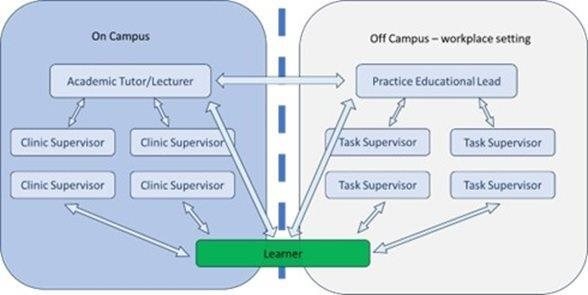
/COO/media/Media/Images/SPOKE/Supervision-Figure-1b.jpg

              Figure 1: Supervisory networks support learner development

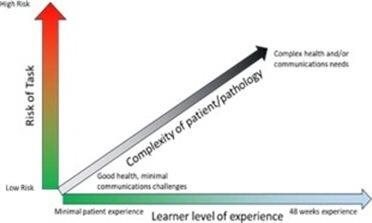
Both learner and supervisor have responsibilities to ensure that patient safety is assured, and legal obligations are met, as reflected in the GOC standards during this process. This assurance comes from making informed judgements about risk, whilst enabling learner development towards independence as a practitioner. A diagrammatic representation of the factors underlying these judgements, in line with the GOC standards, is provided in Figure 2 below.

/COO/media/Media/Images/SPOKE/Supervision-Figure-2_1.jpg

Figure 2

During a typical week of workplace clinical learning in a primary setting, a student might be expected to spend 20 hours in a testing room or dispensing clinic, interleaved with case discussions and feedback from one or more supervisors. They will also need to spend time documenting and reflecting on their experiences, and the supervisor may use these records, as well as the contemporaneous patient records to monitor the student’s progress. In the early days students will require more direct observation, and be able to see fewer patients, than students who are near to qualifying.

Worked examples of what is required and potential time commitments for Practice Leads and Task Supervisors are provided 

No, provided you are working in an environment where others can supervise, a team can be formed to support the student. If you are working alone, it would still be possible under the new ETR arrangements to share supervision of a student between practices or other eyecare settings, so that the supervisory team works across different premises.

This will depend on the arrangements made in your workplace, consulting room space and how many staff members are able and available to supervise. In a larger practice with more than one member of staff who can supervise, it would be possible to supervise more than one student, and for all the students in the practice to have more than one supervisor. The ETR provide greater opportunities for teamwork in supervising a student(s) and it is expected that team arrangements will become much more common.

Yes, provided you can meet requirements such as having a separate consulting room for the student to use and holding sufficient experience to meet the requirements for the placement. If the student is only working in your practice and you are the only supervisor, you would need to bear in mind that there would be a requirement for you to observe their consultations directly in the early stages, and optometry students are expected to spend around 20 hours per week in the testing room. 

CLO qualifications have similar requirements for supervision as ophthalmic dispensing, but supervisors must be available with the required scope of practice. IP qualifications placements are much shorter, but have more specific case mix needs, and normally require interaction with a specialist facility– although where IP services are commissioned and an IP qualified ophthalmic practitioner is available to supervise this may still be possible.

Another option would be for you to share a student with another workplace (e.g. another fixed practice, a domiciliary practice or a hospital) and work with them to determine who is responsible for the various aspects of student training.

Yes, but as with the questions about small practices, the most practical approach may be to share a student with, for example, a high street practice or hospital and supervise them for a set number of days each week in domiciliary settings. These opportunities are popular with students as they provide more diverse experience.

Students need to document and log patient consultations and keep notes and reflections on their activity and learning. A supervisor is required to check and sign off records and provide feedback but can use a variety of methods for this depending on supervisor and student preferences and the activity or skill being observed or discussed.

Optometry

  • For CLiP supervisors, all records will be maintained in the CLiP Portal, and its tools and functionality will mean there is no ‘paper’ involved, and the relevant records are organised and easily accessible
  • For Optometry Manchester supervisors, students will have access to a tracking system hosted by the University where they will be able to record feedback on progress in clinical activities
  • For NES FTY supervisors, an e-portfolio hosted by NHS Scotland will serve as a central electronic record of each student’s evidence and progress. This e-portfolio will be accessible  to all individuals involved in supporting the student throughout their training.

Ophthalmic Dispensing

  • For ABDO supervisors, students and supervisors retain oversight of their own tracking sheets, records of evidence and reflective progress, all completed and submitted online for marking and feedback at staged intervals
  • ARU (awaiting content)
  • GCU (awaiting content)
  • Lancs (awaiting content)

Contact Lens Opticians

  • For ABDO contact lens supervisors, trainees and their supervisors retain oversight of the tracking sheets, records of evidence and reflective progress, all completed and submitted online for marking and feedback at staged intervals.

Independent Prescribing

  • Mentors for trainees who are completing a Handbook qualification, culminating in the College Common Final Assessment should consult the College of Optometrists website for more information
  • Supervisors and students on ETR qualifications should consult their university education provider for further advice.